Springbok Weather & Climate: Best Time to Visit
Average temperatures, rainfall, sunshine and the best time to visit Springbok.
Climate overview of Springbok
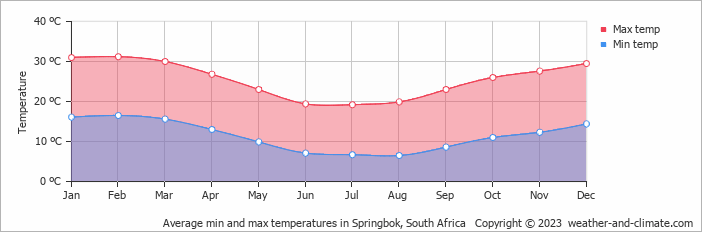
The climate in Springbok, Northern Cape, South Africa, is marked by large temperature swings across the seasons, ranging from 31°C (88°F) in February to 19°C (66°F) in August.
The city has an arid climate, receiving only 173 mm (6.8 in) of rainfall per year. The sunniest month is January, with 12.9 hours of sunshine per day on average.
Springbok Weather by Month
Pick a month to see the average temperature, rainfall and sunshine in Springbok — and find the best time to visit.
Monthly Temperature in Springbok
In Springbok, temperatures differ significantly between summer and winter months. On average, daytime temperatures range from a very warm 31°C (88°F) in February to a pleasant 19°C (66°F) in August.
Nighttime temperatures range from 17°C (63°F) in February to 7°C (45°F) in August.
Check out our detailed temperature page for more information.
Temperature ranges by month
Rainfall in Springbok
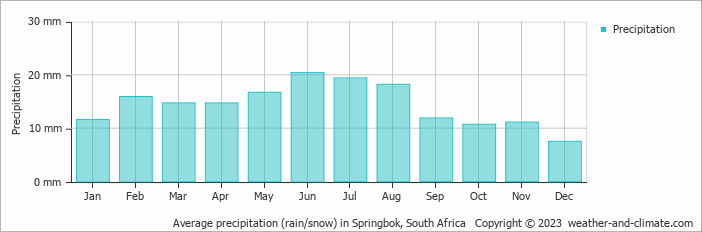
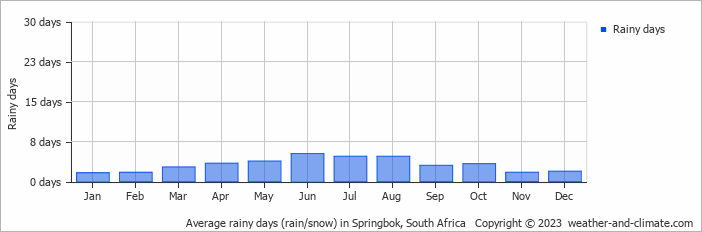
Springbok sits in an arid zone with minimal moisture, averaging 173 mm (6.8 in) of rainfall per year. The seasons in Springbok bring significant changes in precipitation. The wettest month, June, receives low rainfall, with an average of 20 mm (0.8 in) of precipitation. This rainfall is distributed across 5 rainy days.
In contrast, the driest month, December, experiences much less rainfall, totaling 7.5 mm (0.3 in) over 2 rainy days. These distinct seasonal differences provide diverse experiences throughout the year. For more details, please visit our Springbok Precipitation page.
The mean monthly precipitation over the year, including rain, hail, and snow
The average number of days each month with precipitation
Sunshine Hours in Springbok
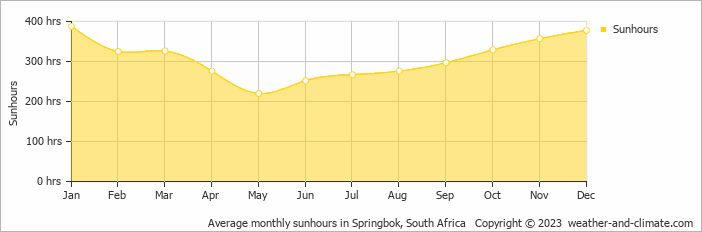
In Springbok, summer days are longer and more sunny, with daily sunshine hours peaking at 12.9 hours in January. As the darker season arrives, the brightness of the sun becomes less. May sees a soft sun for only 7.3 hours per average day.
Visit our detailed sunshine hours page for more information.
Monthly hours of sunshine
Daily hours of sunshine
Best Time to Visit Springbok
While rain is rare, remember to stay hydrated and protect yourself from the sun while you're outside. Looking for inspiration on where to travel this year? We have a tool that recommends destinations based on your ideal conditions. Find out where to go with our weather planner.
Frequently asked questions about the climate in Springbok
What is the best time to visit Springbok?
April, May, June, July, August, September, October and November typically offer the most optimal weather in Springbok. In contrast, January, February, March and December tend to have less optimal conditions. Springbok has a distinct dry season from January to December.
What temperatures can I expect in Springbok?
Daytime highs range from 19°C (66°F) in August to 31°C (88°F) in February. Nighttime lows range from 7°C (45°F) to 17°C (63°F). Temperatures vary considerably through the year.
How much rain does Springbok get?
Annual rainfall is around 173 mm (6.8 in). June is the wettest month with 20 mm (0.8 in), while December is the driest with 7.5 mm (0.3 in).
How sunny is Springbok?
Springbok receives around 3,691 hours of sunshine per year. January is the sunniest month with 388 hours, while May is the cloudiest with just 220 hours. Overall, Springbok enjoys abundant sunshine.
Springbok 3-Day Forecast
Springbok 3-Day Forecast
Springbok on the map
Springbok is highlighted — select any city to see its climate.
Popular this month
Where to go in July — average daytime high across popular destinations.
 Durban
 23°C (73°F) Pretoria
 21°C (70°F) Gqeberha20°C (68°F) Johannesburg20°C (68°F) Knysna19°C (66°F) Cape Town17°C (63°F) Hermanus
 17°C (63°F) Stellenbosch
 17°C (63°F)


Bucket list
Need travel inspiration? Check out our bucket list articles and be inspired.
Visit Kruger Park in South Africa
Are you going to South Africa, then you cannot skip the Kruger Park. The Kruger Park is one of the most beautiful and largest safari parks in the world.
One of South Africa's most spectacular private game reserves
Sabi Sand Game Reserve is one of South Africa's most spectacular private game reserves. The chance that you see the entire Big Five is high in winter (June - August).
Stay in the world's largest open-air gallery
Vast mountains, beautiful nature, tranquility and the possibility of hiking and seeing fascinating rock paintings. This can all be experienced at the Cederberg Mountains.
Kwazulu Natal
Countless beautiful landscapes, a colorful collection of cultures, wildlife parks, busy and deserted beaches, lively cities, small villages and a subtropical climate.