Pokhara Weather & Climate: Best Time to Visit
Average temperatures, rainfall, sunshine and the best time to visit Pokhara.
Climate overview of Pokhara
Pokhara is located near the border with Tibet, in central Nepal. This medium-sized city sits on Lake Phewa and offers spectacular views of the Annapurna Mountains. The surrounding nature is stunning, providing plenty of opportunities for scenic walks. The Annapurna Mountains are truly breathtaking, and if you climb even higher, you’ll get a stunning view of the Himalayas in the background.
Pokhara has a tropical savanna climate, with several months receiving well below 60 mm (2.4 in) of rainfall. Winter and spring are particularly dry, while the summer months bring prolonged heavy rainfall. Due to the high peaks surrounding Pokhara, the city experiences more rainfall than other parts of the region. As the air rises rapidly over the mountains, it cools quickly, causing frequent and intense precipitation. This makes the summer months especially wet.
Pokhara Weather by Month
Pick a month to see the average temperature, rainfall and sunshine in Pokhara — and find the best time to visit.

Monthly Temperature in Pokhara
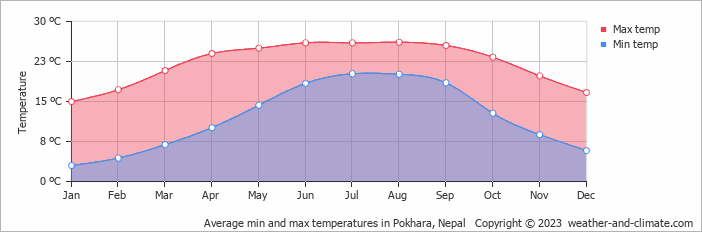
In Pokhara, temperatures differ significantly between summer and winter months. On average, daytime temperatures range from a very warm 31°C (88°F) in June to a pleasant 20°C (68°F) in January.
Nighttime temperatures range from 22°C (72°F) in June to 7°C (45°F) in January.
Check out our detailed temperature page for more information.
Temperature ranges by month
Rainfall in Pokhara
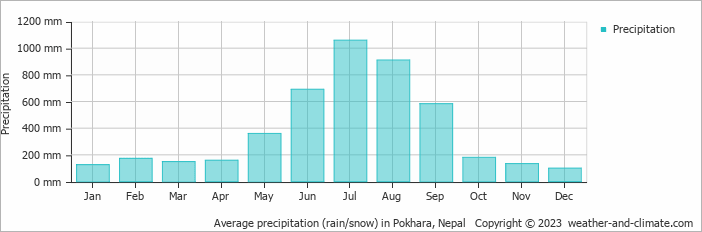
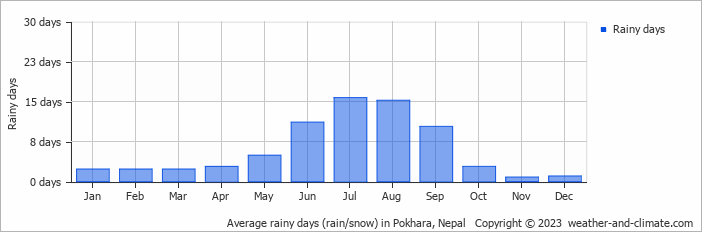
Pokhara experiences significant rainfall throughout the year, averaging 3870 mm (152 in) of precipitation annually. The seasons in Pokhara bring significant changes in precipitation. The wettest month, July, receives heavy rainfall, with an average of 943 mm (37 in) of precipitation. This rainfall is distributed across 16 rainy days.
In contrast, the driest month, December, experiences much less rainfall, totaling 12 mm (0.5 in) over a single rainy day. These distinct seasonal differences provide diverse experiences throughout the year. For more details, please visit our Pokhara Precipitation page.
The mean monthly precipitation over the year, including rain, hail, and snow
The average number of days each month with precipitation
Sunshine Hours in Pokhara
In Pokhara, summer days are longer and more sunny, with daily sunshine hours peaking at 7.6 hours in March. As the darker season arrives, the brightness of the sun becomes less. August sees a soft sun for only 3.2 hours per average day.
Visit our detailed sunshine hours page for more information.
Monthly hours of sunshine

Daily hours of sunshine
Wind Speed in Pokhara
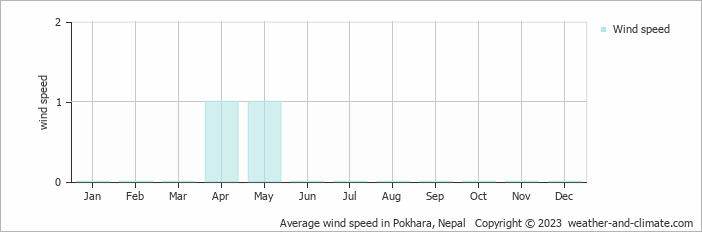
The mean wind speed varies between () and 1 m/s (2 knots) throughout the year. It is lowest in January, February, March, June, July, August, September, October, November and December and highest during April and May. What does this mean?
The mean monthly wind speed over the year (meters per second)
Best Time to Visit Pokhara
Be prepared for heavier rainfall during May, June, July, August and September, the wettest period of the year. Need help choosing your next travel destination? We offer a specialized tool that matches you with locations based on your weather preferences. Explore destinations that suit your climate preferences.
Frequently asked questions about the climate in Pokhara
What is the best time to visit Pokhara?
January, February, March, November and December typically offer the most optimal weather in Pokhara. In contrast, May, June, July, August and September tend to have less optimal conditions. Pokhara has distinct dry (November to February) and wet (May to September) seasons.
What temperatures can I expect in Pokhara?
Daytime highs range from 20°C (68°F) in January to 31°C (88°F) in June. Nighttime lows range from 7°C (45°F) to 22°C (72°F). Temperatures vary considerably through the year.
How much rain does Pokhara get?
Annual rainfall is around 3870 mm (152 in). July is the wettest month with 943 mm (37 in), while December is the driest with 12 mm (0.5 in).
How sunny is Pokhara?
Pokhara receives around 2,100 hours of sunshine per year. March is the sunniest month with 229 hours, while August is the cloudiest with just 97 hours. Overall, Pokhara enjoys abundant sunshine.
Pokhara 3-Day Forecast
Pokhara 3-Day Forecast
Pokhara on the map
Pokhara is highlighted — select any city to see its climate.
Popular this month
Where to go in July — average daytime high across popular destinations.
 Rummindei
 33°C (91°F) Sauraha32°C (90°F) Pokhara30°C (86°F) Dhulikhel27°C (81°F) Nagarkot26°C (79°F) Bhaktapur27°C (81°F) Kathmandu26°C (79°F) Lalitpur27°C (81°F)


Bucket list
Need travel inspiration? Check out our bucket list articles and be inspired.
 10 Hidden gems in Asia you need to visit
Explore 10 hidden gems in Asia offering authentic experiences, from pristine beaches and remote islands to cultural treks and peaceful mountain villages.
A pilgrimage through Nepal: from the Himalayas to the Heart
Go on a spiritual journey through Nepal, discovering its rich heritage, breathtaking Himalayas, sacred monasteries, and vibrant culture.
Jaljale Himal: Nepal’s Untouched Trekking Paradise
Explore Jaljale Himal in eastern Nepal, offering remote trekking, stunning peaks, and rich culture. Best time: October-December and February-March.