


 Explore the Yasawa Islands
The Yasawa islands are known for their tropical beautiful beaches and the picturesque atmosphere. You might want to cross it of your bucket list.
Average temperatures, rainfall, sunshine and the best time to visit Suva.
 –
–
Suva is the capital of Fiji, a Pacific island nation in Oceania made up of over 300 islands. It is located on Viti Levu, the country's largest island.
Suva has a tropical rainforest climate according to Köppen’s classification, with little temperature variation throughout the year. The warmer, wetter season lasts from November to April, while the May to October period is slightly cooler and significantly drier. On average, Suva receives around 2400 mm (94 in) of rainfall annually, though this can increase significantly in years affected by severe tropical depressions or hurricanes.
Pick a month to see the average temperature, rainfall and sunshine in Suva - and find the best time to visit.
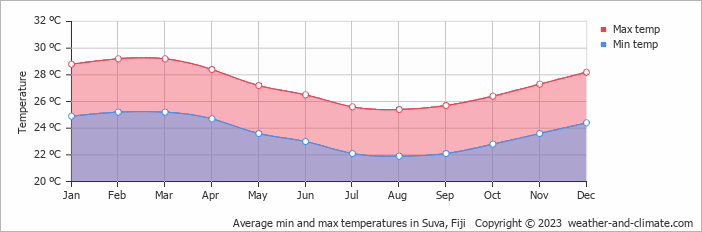
The temperature in Suva remains steady throughout the year, providing a consistently comfortable climate. Typically, average maximum daytime temperatures range from a comfortable 29°C (84°F) in February to a comfortable 25°C (77°F) in the coolest month, August.
Nights vary from 25°C (77°F) in February to around 22°C (72°F) during the colder months.
Check out our detailed temperature page for more information.
Suva has a relatively rainy climate with high precipitation levels, averaging 2402 mm (95 in) of rainfall annually. The climate in Suva shows significant variation throughout the year. Expect heavy rainfall in January, the wettest month, with an average of 293 mm (12 in) of precipitation over 18 rainy days.
In contrast, the driest month July offers drier and sunnier days, with around 103 mm (4.1 in) of rainfall over 19 rainy days. For more details, please visit our Suva Precipitation page.


Monthly ratings reflect general weather comfort, based on daytime temperature and rainfall. Swimming and winter conditions are highlighted separately where relevant.
May, June, July, August and September typically offer the most optimal weather in Suva. In contrast, January, February and December tend to have less optimal conditions. Suva has a distinct rainy season from October to April.
Daytime highs range from 25°C (77°F) in August to 29°C (84°F) in February. Nighttime lows range from 22°C (72°F) to 25°C (77°F). Temperatures stay relatively stable year-round.
Annual rainfall is around 2402 mm (95 in). January is the wettest month with 293 mm (12 in), while July is the driest with 103 mm (4.1 in).
Suva is highlighted - select any city to see its climate.
Where to go in October - average daytime high across popular destinations.
Nadi 29°C (84°F) Denarau
 29°C (84°F) Rotuma
 29°C (84°F) Matei27°C (81°F) Savusavu27°C (81°F) Pacific Harbour26°C (79°F) Suva26°C (79°F) Korolevu27°C (81°F)
 Need travel inspiration? Check out our bucket list articles and be inspired.
Explore the Yasawa Islands
The Yasawa islands are known for their tropical beautiful beaches and the picturesque atmosphere. You might want to cross it of your bucket list.

 An alternative way to discover Sydney
We have made an overview of the sights in Sydney that you must see if you want to visit Sydney in an alternative way.

 The Tongariro Crossing in New Zealand
It is called the most beautiful walk in New Zealand, the Tongariro Crossing. The official hiking season starts late October until end of April.
 The most relaxed and alternative area of Australia is called the Byron Shire
The Byron Shire is one of the most pretty areas in the world. Not only in terms on natural beauty, also the relaxed vibe and people make this an area that remains close to your heart.