

Johannesburg Sunshine Hours by Month
To truly understand a climate, we must look at its sunshine. This page shows the total number of hours of direct sunlight per month and the average hours per day in Johannesburg, Gauteng, South Africa. The numbers reflect climate data gathered over a 30-year period, from 1990 to 2020.
Monthly hours of sunshine
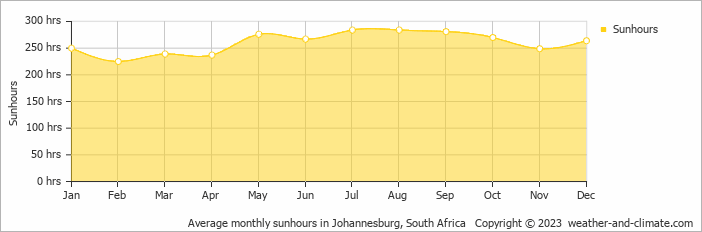
Johannesburg experiences sunny spells throughout the year. The sunniest month, August, sees up to 284 hours of sunshine, while February, the least sunny month, still provides a respectable 225 hours. The total annual sunshine amounts to 3126 hours.
Daily hours of sunshine
This means you can enjoy sunny spells year-round. July sees up to 9.5 hours of daily sunshine, perfect for a sunny trip. February, the least sunny month, still offers a generous 7.5 hours of sun despite this cloudier / rainier time of the year.
Average percent of sunshine
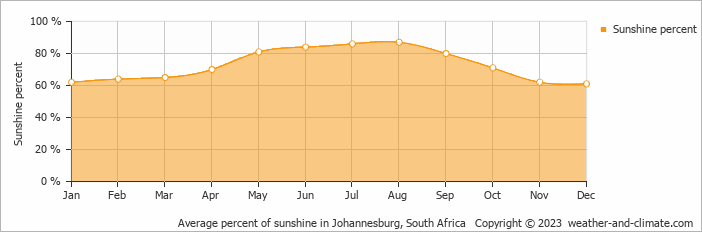
On average the sun shines 87% of the time during the day in August, the highest percentage of any month. December has the lowest percentage at 61%.
Johannesburg vs Major Cities: Sunshine Compared
Johannesburg enjoys an average of 3126 hours of sunshine annually. Let’s compare this with some popular tourist destinations:
Athens, Greece, enjoys 2769 hours of sunshine each year, making it one of the sunniest destinations in the Mediterranean region.
In contrast, Juneau, Alaska, receives only about 1523 hours of sunshine per year and is known for its very short days in winter and frequently overcast conditions.
The climate in San Francisco, USA, includes 3072 hours of sunshine annually, thanks to its mild coastal weather.
In Tokyo, Japan, the average annual sunshine is 1930 hours, with sunny periods between rainy seasons.
Related Climate Data for Johannesburg
December, Johannesburg’s wettest month, receives 133 mm (5.2 in) of rainfall and has a maximum daytime temperature of 27°C (81°F). During the driest month July you can expect a temperature of 20°C (68°F).
For more detailed insights into the city’s temperatures, check out our Temperature page. To explore more about precipitation patterns, visit our Johannesburg Precipitation page.


