

Honolulu (HI) Sunshine Hours by Month
Sunshine is key to understanding how a place experiences its seasons. This page shows the total number of hours of direct sunlight per month and the average hours per day in Honolulu, Hawaii, United States of America. The figures are based on a 30-year period (1990–2020) to provide a reliable average.
Monthly hours of sunshine
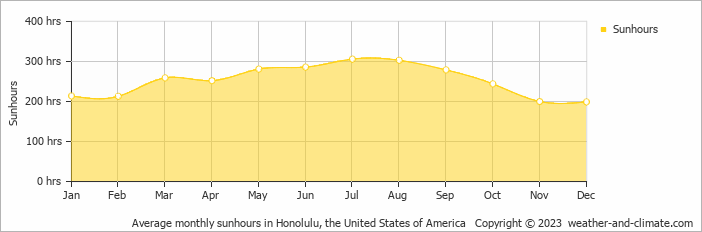
Honolulu experiences sunny spells throughout the year. The sunniest month, July, sees up to 306 hours of sunshine, while December, the least sunny month, still provides a respectable 199 hours. The total annual sunshine amounts to 3036 hours.
Daily hours of sunshine
This means you can enjoy sunny spells year-round. July sees up to 10.2 hours of daily sunshine, perfect for a sunny trip. December, the least sunny month, still offers a generous 6.6 hours of sun despite this cloudier / rainier time of the year.
Average percent of sunshine
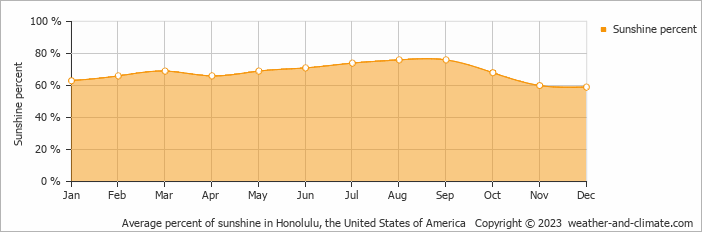
On average the sun shines 76% of the time during the day in August, the highest percentage of any month. December has the lowest percentage at 59%.
Honolulu vs Major Cities: Sunshine Compared
Honolulu enjoys an average of 3036 hours of sunshine annually. Let’s compare this with some popular tourist destinations:
In Lisbon, Portugal, there are approximately 2801 hours of sunshine annually, highlighting its warm and sunny Mediterranean climate.
In contrast, Brussels, Belgium, receives only about 1590 hours of sunshine per year, known for its frequently overcast and rainy skies.
Boston, USA, enjoys 2629 hours of sunshine annually, with distinct seasons and many bright, sunny days.
In Tokyo, Japan, the average annual sunshine is 1930 hours, with sunny periods between rainy seasons.
Related Climate Data for Honolulu
December, Honolulu’s wettest month, receives 23 mm (0.9 in) of rainfall and has a maximum daytime temperature of 26°C (79°F). During the driest month July you can expect a temperature of 28°C (82°F).
For more detailed insights into the city’s temperatures, check out our Temperature page. To explore more about precipitation patterns, visit our Honolulu Precipitation page.


